Measure Your Lawn Size Online
Find out how much square footage of lawn you have without measuring it by hand. Search an address, trace the grass from aerial imagery, and get the lawn area in square feet, square metres, acres, or hectares.
Free to start. No sign-up required.
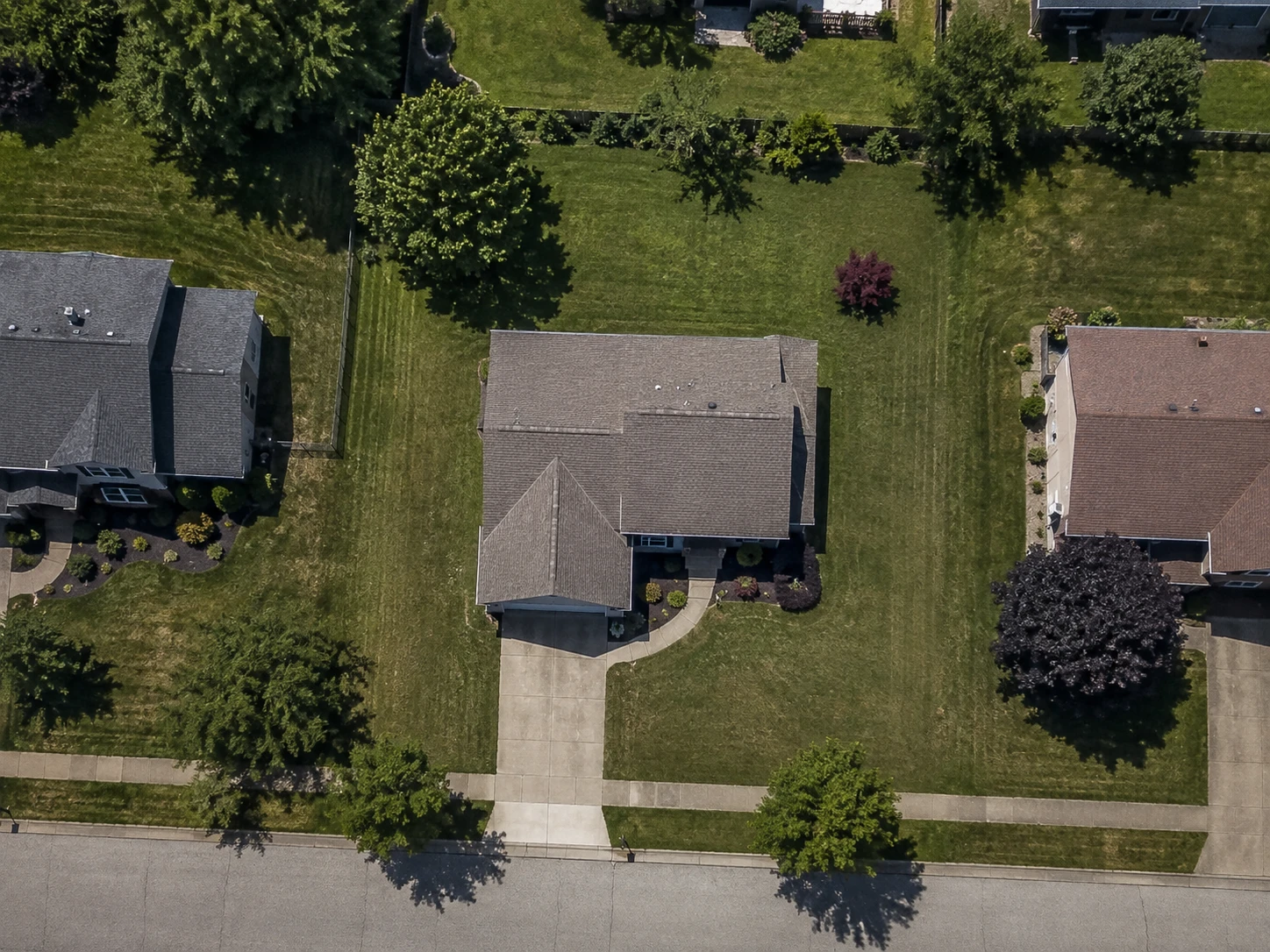
To measure your lawn online, search the property address, choose a clear aerial image, and trace the grass you want included. Leave out the house, the driveway, patios, planting beds and anything else that is not turf. The finished outline gives you the lawn area in square feet, square metres, acres, or hectares.
Your lot size is not your lawn size.
A listing that says the lot is 10,000 square feet (about 929 m²) is describing the land inside the property boundary. Every square foot of it counts, including the part with a house standing on it.
Lawn size is what is left once everything that is not grass comes out. On most residential properties that is a large subtraction, and the two figures are far enough apart that using one in place of the other will send you home with the wrong amount of almost anything.
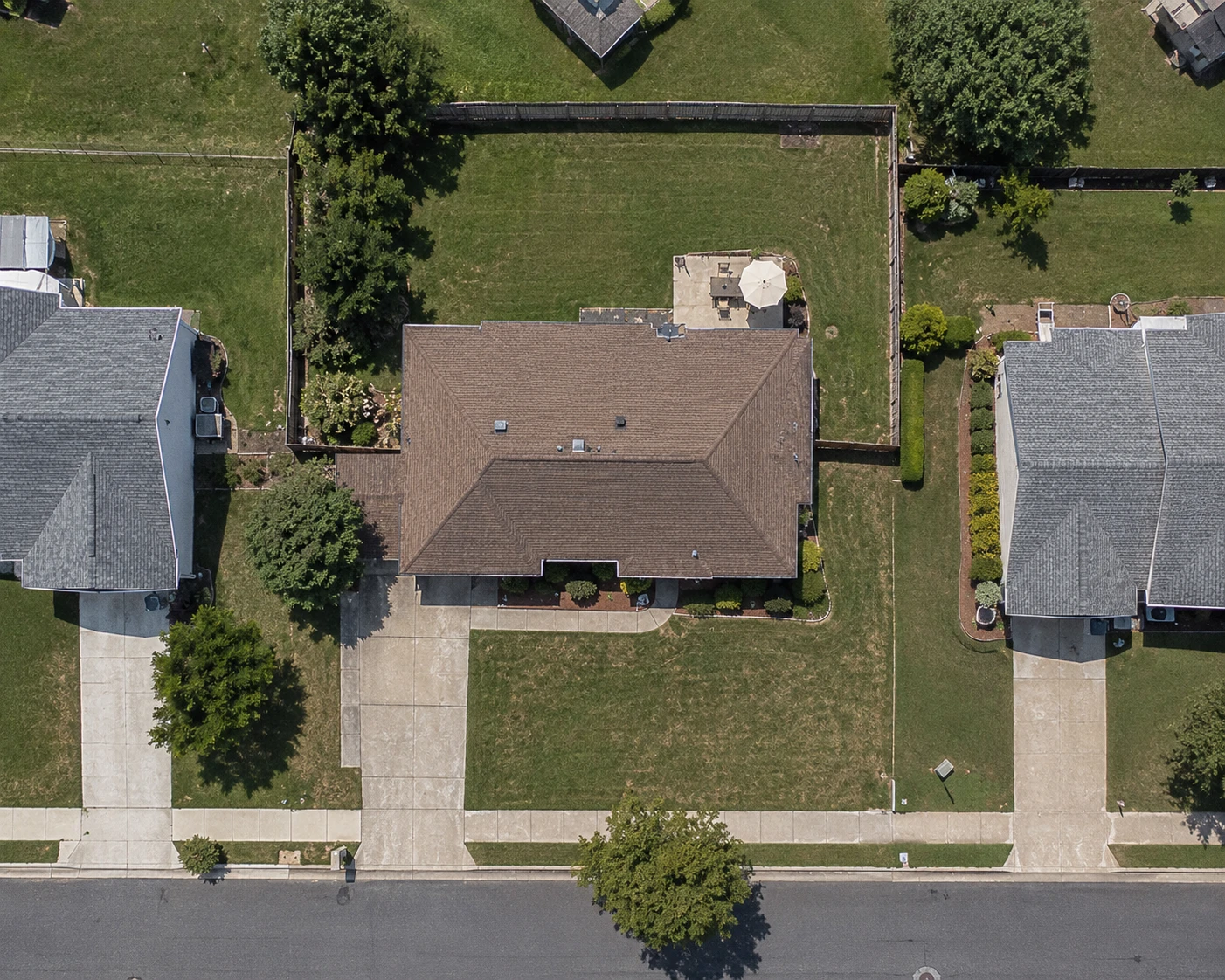
The same property, traced twice. One outline follows the whole parcel. The other follows only the grass, and the difference between them is not rounding.
The lot, the house and the lawn are each measured. The third line is everything paved or planted, which is whatever is left once the other two come out. More than a third of this property is not lawn, and that is an ordinary result rather than an extreme one.
How to measure your lawn online.
Search the property address
Enter the address and FindPropertySize opens the property from above.
Choose the clearest aerial image
Compare the available imagery and keep whichever view shows the edges of the grass most clearly.
Start tracing the lawn
Place a point at one corner of the grass and work your way around the area you want measured.
Follow the grass around everything that is not grass
Take the outline in around the house, the driveway, the patio and the planting beds so the shape holds only turf. Add points wherever the edge changes direction.
Close the shape and read the area
Closing the outline reports the lawn area in square feet, square metres, acres or hectares. Drag any point to adjust it against the imagery.
The full method, from choosing the area to refining the trace
What should you include in your lawn measurement?
Lawn area means the turf, and the useful test is whether you would put grass seed on it. Everything else on the property is measurable separately when you need it.
| Surface | In the lawn measurement? | Why |
|---|---|---|
| Front, back and side lawn | Include | This is the turf itself. The sections do not have to touch each other to belong in the same total. |
| Grass under and around trees | Include | A canopy hides the ground from the imagery. It does not mean there is no grass underneath it. |
| The strip between sidewalk and street | Your call | It is usually turf somebody mows, so whether it belongs in the figure depends on what the figure is for. |
| House, garage and sheds | Exclude | A roof is not grass, and the building footprint is one of the largest things standing inside a lot. |
| Driveway, sidewalk and walkways | Exclude | Paving runs through most residential yards and takes a real amount of turf out of the total. |
| Patio, deck and pool | Exclude | Hard surfaces and water are not turf, and they tend to sit in the part of the yard people forget to subtract. |
| Mulch and planting beds | Exclude | Beds are landscaping rather than lawn, and they usually follow the house and the walkways closely. |
Tree cover is the one that trips people up. If you know there is grass under the canopy and you want it counted, trace the lawn under and around the tree as closely as the image allows rather than cutting the shape short at the leaves.
The rest is a decision about what the number is for. A figure for seed should hold turf and nothing else. If you are treating the whole yard rather than the grass, measure the yard as its own area so you end up with both numbers.
Real lawns aren’t perfect rectangles.
Length times width is a fair answer for a rectangle of grass and almost nothing else. A house sits in the middle of the area. A driveway cuts a strip out of one side. Beds curve along the foundation, side yards pinch to a few feet between buildings, and a patio or a pool takes a bite out of the back.
Front and back lawns are usually different shapes on the same property, so one rectangle was never going to describe both. Tracing the grass handles all of it without anything having to be simplified first, which is why a lawn size calculator built on aerial imagery never asks you for a length or a width.
What can you use lawn square footage for?
Almost everything a lawn needs is sold or priced by the area it covers, so one measurement is the starting figure for most of it.
| What you are planning | Why the lawn area matters |
|---|---|
| Grass seed | Seed bags state the area they cover, so the turf figure is what you compare that coverage against. |
| Fertilizer | Coverage is printed on the bag the same way, so knowing how much turf there is means you can estimate how much to buy. |
| Sod | Sod is bought by area, so the figure to plan against is the turf being replaced rather than the whole yard. |
| Lawn treatments | Weed, pest and soil products are sold by coverage area too. Follow the product’s own instructions for how much to apply. |
| Irrigation | How much turf there is, and where it sits, is the scale of what has to be watered. |
| Service estimates | A contractor pricing mowing, aeration or seeding is pricing the turf, not the parcel it sits on. |
Should you measure a lawn in square feet or acres?
Whichever unit the products you buy are sold in. In the U.S., grass seed, fertilizer, sod and lawn treatments list their coverage in square feet, and residential lawns run to a few thousand of them — so the figure you measure is already in the unit you will be comparing it against. Where measurements are metric, the same products list coverage in square metres, and that is the number to measure in instead.
Acres and hectares become the convenient units once a lawn is large enough that its square footage stops being easy to picture. One acre is 43,560 square feet, or about 4,046.86 square metres; one hectare is 10,000 square metres, and an acre is 0.4047 of one.
| Square feet | Square metres | Acres | Hectares |
|---|---|---|---|
| 5,000 | 465 | 0.115 | 0.0465 |
| 10,000 | 929 | 0.230 | 0.0929 |
| 21,780 | 2,023 | 0.500 | 0.2023 |
| 43,560 | 4,047 | 1.000 | 0.4047 |
How accurate is an online lawn measurement?
Accurate enough to buy materials and price work against, when the imagery is clear and the edges are traced with some care. What moves the result is how sharp the imagery is, how well it lines up with the ground, whether shadows or tree cover hide part of the grass, how closely the outline follows the real edge, and the decisions you made about what counted as lawn in the first place.
The last of those is usually the largest. Two people measuring the same yard can differ by a thousand square feet without either of them clicking carelessly, because one included the beds and the strip by the street and the other did not.
A measured surface is not a surveyed boundary.
Measuring a lawn from imagery tells you how much of a surface is there. It does not establish where a property line runs, and it is not a substitute for a survey when a legal boundary is what a decision turns on.
Measure lawns before you arrive.
Lawn care and landscaping crews measure the same way, one address at a time, without driving out to the property first. A traced turf area is enough to quote mowing, estimate seed, fertilizer and sod quantities, and see how a route of jobs adds up before anyone is scheduled.
It also makes a quote something a customer can look at. A measured area on an aerial image of their own property explains a price in a way a flat rate does not.
Lawn size questions
How do I calculate the square footage of my lawn?
Search the property address, choose a clear aerial image, and trace the outline of the grass you want measured. Take the shape in around the house, the driveway, the patio and any planting beds so it holds only turf. The finished outline reports the lawn area, and the same measurement can be read in square feet, square metres, acres or hectares.
Can I measure my lawn using satellite imagery?
Yes. Aerial and satellite imagery is detailed enough at residential scale to see where grass stops and paving, beds or buildings begin, which is what a lawn measurement depends on. The result is an estimate of surface area rather than a survey.
Can I measure my lawn by address?
Yes. The address is only how the property gets on screen. Once it is there, the lawn is measured by tracing the grass on the aerial image, so nothing depends on knowing the lot dimensions in advance.
Does lawn square footage include the house?
No. Lawn area is the turf alone. The house, garage, sheds, driveway, walkways, patio, deck and pool all sit inside the lot without being part of the lawn, which is why a lot figure is usually much larger than a lawn figure on the same property.
Should I include landscaping beds in lawn size?
Usually not. Beds are landscaping rather than turf, and products sold by lawn coverage are meant for the grass. If you are measuring for something that treats the whole yard rather than the lawn, measure the beds as their own area so you have both numbers.
Is yard size the same as lawn size or lot size?
All three are different. Lot size is the total area of the parcel, including the house and everything standing on it. Yard size usually means the outdoor space around the home, which can hold a driveway, a patio, beds and structures as well as grass. Lawn size is the turf on its own, and it is the figure lawn products and lawn services are priced against.
How many square feet are in an acre?
One acre contains 43,560 square feet, which is about 4,046.86 square metres or 0.4047 hectares. A 10,000-square-foot lawn is about 0.23 acres, and 21,780 square feet is exactly half an acre.
How accurate are online lawn measurements?
Accurate enough to plan and buy against when the imagery is clear and the grass edges are traced carefully. How sharp the imagery is, shadows, tree cover and the decisions you make about what counts as lawn all affect the result, so treat it as a measurement of surface area rather than as survey work.
Can I use lawn square footage to estimate seed or fertilizer?
Lawn products are sold by the area they cover, so the turf square footage is the number to compare a product’s stated coverage against. How much to apply comes from the product’s own instructions. Measure the turf rather than the lot so you are not buying for the driveway.
Related measurement tools
Ready to measure your lawn?
Search the address, trace the grass, and read the square footage.
Free to start. No credit card required.